Feminism – why is it so hard to understand?
By: Tisya
If I were to ask people what feminism is, they may define it as equal rights for women, or they may not be able to define it at all. So people must understand, especially in an international community like ISK, which promotes the acceptance of all genders, what feminism is, and why it is important to be one.
First of all, a common area for confusion is the definition of feminism. Feminism is, according to the International Women’s Development Agency, about all genders having equal rights and social, political and cultural opportunities. This definition is key to our understanding of this ideology, since many people believe that feminism only focuses on women and providing them with their rights and opportunities. Now, this is partially right, because women should have equal rights as any gender, though often to men – equal pay, equal opportunities to authorial positions, and the equal right to speak up and express their opinions. However, it is not solely focused on women’s rights, but on all genders.
Building on the idea of feminism, why do people find it hard to understand? Well, many aspects can play a big role in the misunderstanding of the term, especially in modern times. After the invention of the internet, people are easily able to share ideas and opinions with everyone around the world, and this really is a great mode of advocacy. But it can also be used to spread false news, which is why, when some creators online spread the idea that feminism focuses only on the well-being of women and ignores all other genders, such an idea becomes embedded in the heads of people who might already be confused.
At the root of the issue is also women’s attitude. Many times, women believe that being a feminist means they can’t be a stay-at-home mother, have to work, or are forced to not change their surname after marriage. What needs to happen is to spread the awareness that feminism is what gives you a choice. Whether you want to work or not, wear pants or skirts, the choice should be yours.,
Feminism has become a term so hard to understand. From something so basic as having rights to being interpreted wrongly or not being understood is why it’s essential to educate oneself and others on the term, so that moving forward, everyone can obtain basic rights and opportunities in our society.
“I am as human as anyone”: James Gunn’s Superman is the male role model the world needs right now
Or the need for basic human empathy in a world quickly descending towards fascism
By: Maya

Though I am not an avid watcher of DC superhero movies, Superman (2025) has caught my attention in its portrayal of our current political climate and its empathetic protagonist. The film, directed by James Gunn, has debuted to a box office of 600 million dollars globally and has received its flowers online with many praising Gunn and David Corenswet, who plays the titular character, for their deep understanding of Superman as a character and what he stands for. Again, I am not familiar with DC media, but I find myself drawn to the collective reaction to Corenswet’s portrayal of Superman and what it says about the direction society is headed toward.
The film follows the typical narrative of Superman stories, with Superman, an alien sent from his destroyed home planet of Krypton, living his life as Clark Kent, a journalist working for the Daily Planet. While combating the country of Boravia’s violent and incessant invasion of their neighbour, Jarhanpur, Superman must also face his arch nemesis, billionaire Lex Luthor, in his attempts to end Superman for good. When Superman finds out that Luthor himself had been funding Boravia’s invasion by providing billions of dollars’ worth of weapons, he and his coworkers at the Daily Planet document all evidence of Luthor’s corruption to spread the truth to the public and shut him down.
As is expected of the genre, the film takes an optimistic approach to battling oligarchy and colonialism—no one would expect one exposé of a billionaire to put him away for good in the real world—but the film’s resolution speaks to a greater truth about the crucial role that journalism plays, especially in times of conflict. With the rise of social media platforms and our mobile phones, information is the most accessible it has ever been, and we are now also the most exposed we have ever been to other people’s opinions. We are quick to receive news and are quick to respond, creating a world in which we are pressured to quickly take a stance—are you for or against? This culture of rapid response has created the extremely polarised society that we live in online, where nuance goes to die. But what’s worse than two ends of extremes? Having no opinion at all.
The recent trend of ‘nonchalance’, where people are encouraged to act in a manner of cool indifference, has become popular, particularly amongst young men and teenage boys. Though it appears harmless on the surface, it reveals more about our encouragement of a culture where everyone is afraid to express themselves, no one is willing to interact with art in a meaningful way, and bad behaviour amongst young men is allowed. We have allowed figures like Andrew Tate and Elon Musk, pioneers of the current “male loneliness epidemic”, to have a platform, and we have normalised a lack of critical thinking, saying “it’s not that deep”. Actually, it is!
So where does Superman stand in all of this? In a world obsessed with image, diplomacy, and apathy, Superman chooses to engage in the rebellious act of empathy. In his entire superhero career, Superman has one goal: to save as many people as possible. Superman does not care about borders or laws because he has the ability to do anything he wants; therefore, he will do anything he wants. Gunn actively shows Superman caring for buildings, squirrels, and the one person who would have been a single casualty. If he were to be presented with the Trolley Problem, Superman would have found a way to save everyone. It is this dedication to helping everyone and everything regardless of any external factor that is threatening to fascists, who only have the capacity to love under conditions. At the crux of his battles against Lex Luthor, Superman declares, “I am as human as anyone. I love, I-I get scared. I wake up every morning, and despite not knowing what to do, I put one foot in front of the other, and I try to make the best choices that I can.” This statement, which I believe to be Gunn’s thesis for Superman’s entire character, is the antithesis of what our society has become. There is still hope yet.
Catastrophic Floods Devour Pakistan: Economy and Villages Submerge
By: Zainab
In recent years, Pakistan has faced catastrophic floods that have disrupted and weakened the economic flow and daily life. As of the 19th of August, Punjab, Pakistan’s most populated province and agriculturally rich land, had been hit with a severe flood, causing massive destruction of homes and land. Now people suffer from long-term economic strains, which slow down recovery efforts.
In 2022, Pakistan faced devastating floods that submerged a third of the land, leaving millions displaced and infrastructure destroyed. Both the floods in 2022 and 2025 resulted from the prolonged monsoons, which are believed to be triggered by global warming. Pakistan is one of the countries most vulnerable to climate change due to its geographical location, causing exposure to extreme weather, as well as its heavy dependence on water resources for agriculture, which worsens the effects of dangerous downpours and floods.
Punjab, where most floods hit, is the backbone of Pakistan’s agricultural life and economy, with 53% of the land used for agriculture. Over 1.8 million acres of farmland were submerged with floodwater, which affected crops such as rice, cotton, and maize. These crops are essential for consumption and export revenue, with cotton and rice fuelling Pakistan’s economy to a great extent, with rice being Pakistan’s second or third export commodity. Wheat flour prices increased by over 25% during the first week of September all over the country, as Punjab is Pakistan’s leading wheat producer. In addition, the country suffered a 2% loss in its GDP due to the massive agricultural losses, which make up about 24% of Pakistan’s GDP according to Pakistan’s Bureau of Statistics.

Musadiq Malik, a Pakistani politician, reports from Al Jazeera: “These people [working on agriculture] have no economic security, and given our current economic development stage, the government lacks the wherewithal to provide for such a large segment of the population if these gushing floods wash away our infrastructure and devastate agricultural lands. From an economic and agricultural standpoint alone, the potential for devastation is immense,” (Al Jazeera). This demonstrates Pakistan’s weakened economy in the face of these climate disasters. With the majority of the population relying on agriculture for survival and income, the destruction of the farmland is not only deepening the poverty in Pakistan but also reducing the food supply, leaving millions without a stable income or resources.
Additionally, the floods have forced the displacement of many, with thousands of villages being submerged by floodwaters, more specifically, between 1,400 and 4,000 villages. With over 6 million people affected in total across Pakistan since the monsoon rains began in late June, 2.5 million have been internally displaced. They are seeking active refuge in government-run camps or sheltering with other families. Water-borne diseases such as Malaria, dengue, and cholera are also increasing, further adding to the toll for survivors’ already weakened physical state and shaken mental health.
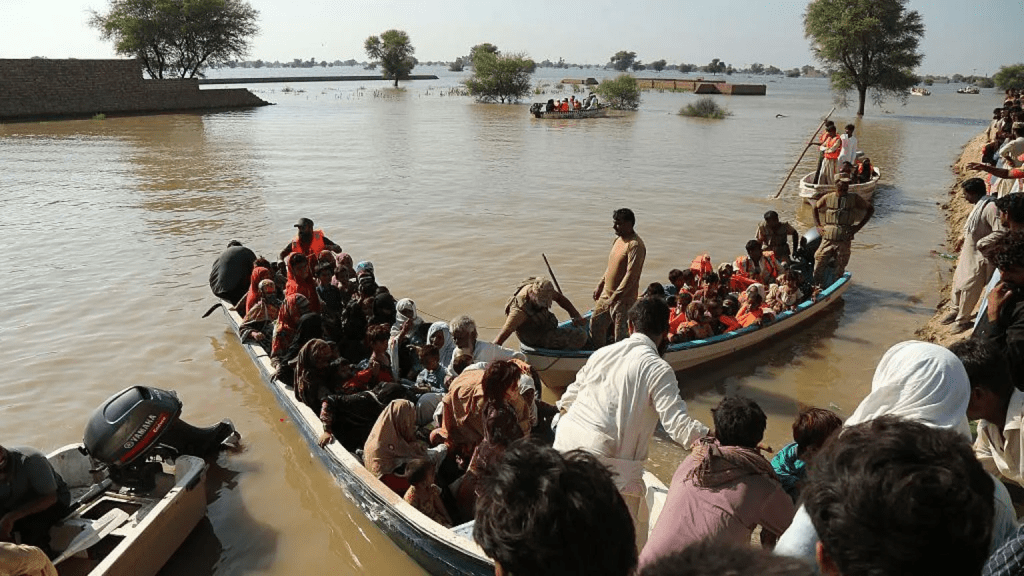
Humanitarian aid is struggling due to the inaccessible areas and destruction: 700km of roads are destroyed or cannot be crossed. Because of this, assistance is only reachable by boat or helicopter.
The floods in Pakistan are evidence of the increasing climate change issue, economic impacts, and humanitarian vulnerability. Punjab’s losses and mass destruction demonstrate how disasters’ long-lasting effects erode livelihoods and food security and endanger public health. Without building more substantial investments for climate and disaster resilience, Pakistan’s development progress will continue to be set back due to climate challenges, leading to repeated problems. However, comparing the 2022 floods, the 2025 floods weren’t worse, meaning that Pakistan has made some progress in disaster management from reflection and international aid. Fewer lives were lost compared to 2022; however, millions still face hardship.
Drawing by Zayd:

 Elements Magazine