We Might Have Found Extraterrestrial Life – But it Happened in 1905
For as long as humankind has been recorded, there have been theories about the cosmos. Is the Earth the centre of the universe? Is our planet flat? What are those sparkly things in the sky? Does life exist in outer space?
What happened?
In April 2025, six researchers published a study on gases and molecules in the atmosphere of the planet K2-18b, a Hycean planet that consists of large oceans and an abundance of hydrogen. Studies like these have been conducted many times, but K2-18b is special. In the atmosphere, scientists found biosignatures – chemical indicators of life – of the gas “dimethyl sulfide” (DMS). While this might not seem like something of significance, the truth is that DMS is only known, on Earth, to be produced by living organisms such as algae. Not only did researchers make this discovery, but according to a New York Times article, they found that the level of DMS is thousands of times higher than on Earth. Multiple scientists infer this to be the strongest evidence yet of life in space.
Firstly, should we care?
People have different opinions on whether finding extraterrestrial life is worth our money and time. On many platforms such as Quora and Reddit, people argue that the large amounts of money can go to solving conflicts, starvation, lack of healthcare, and other global issues. Some believe that finding “aliens” wouldn’t benefit us at all.
Professor Dougherty, a leading scientist in Planet Research, says in an interview with BBC that “The discovery of even simple life will allow us a better understanding about how we might have evolved way back those millions of aeons ago when we first evolved. And so, for me, it’s helping us find our place in the Universe.” On the other hand, Dr Robert Massey, the deputy executive director of the Royal Astronomical Society, states, “I think the discovery of life elsewhere would further reduce our specialness.” Two scientists with two different opinions, whom the science world looks up to. Who’s right? However, humans are known for their curiosity. In many cases, we research just to obtain the knowledge, so perhaps that is enough of a reason.
We want to find life – is it possible?
Even if we wanted to explore this finding further, both researchers at NASA and journalists, like those at The New York Times, are sceptical of whether it is possible. In early April, President Donald Trump of the United States announced a proposition to cut NASA’s federal funding in half. This would especially restrict the construction of a new telescope that focuses on analysing possibly-habitable planets, which would potentially increase our chances of finding solid proof of life. For this study, the researchers used the James Webb Space Telescope (JWST), studying the difference in how the light breaks in the planet’s atmosphere. The new telescope would make much precise readings. However, the reduced budget would also lead to a halt in the search for life completely, not solely to create the new telescope.
K2-18b exists in a solar system 120 light years away from Earth. This means that it takes 120 years for light, which travels 300,000m/s, to reach our eyes. Technically, the data the scientists collected was true 120 Earth years ago, in 1905. It would take another nine years for World War 1 to break out. Does this mean that now, in 2025, life has evolved even further on K2-18b? Will we only find out 100 years from now? Are we even going to find out?
By Elsa
Fast Fashion Fuels Waste and Exploitation
What Is Fast Fashion?
Fast fashion refers to the rapid, cheap production of clothing that aligns with the latest fashion trends. Since the 1990s, the rise of platforms like TikTok and Instagram has intensified this culture, with aesthetics and micro-trends changing rapidly. In 2025, the most prominent fast fashion brands include H&M, Zara, Forever 21, and Shein. While buying new clothes creates a euphoric effect, it comes at great human and environmental costs, which will be explored further in this article.
Behind the Seams: Working Conditions in Fast Fashion
Have you ever wondered where your clothes are made? Major transnational corporations (TNCs) like Zara and H&M have headquarters in high-income countries such as Sweden and Spain, but outsource their production to low-income countries (LICs) like Indonesia, Vietnam, and Bangladesh. Why? Because garment production is one of the most labour-intensive industries in the world, and labour is far cheaper in LICs. Additionally, resource prices such as water are much cheaper and lack of government intervention and control means fewer safety regulations, equality and worker rights in these regions.
To meet demand and maximize profit, human welfare is often deprioritized. Factory workers endure unsafe, unsanitary conditions, typically working 14–16 hour shifts, seven days a week. In Bangladesh, they earn as little as 33 cents per hour. Poor infrastructure also poses fatal risks. This was seen in the 2013 Rana Plaza collapse, which killed over 1,000 workers after they were forced to enter a visibly fragile building.
With a poverty rate of 22.9% in 2025, increased from 20.5% in 2024, Bangladesh reflects another major issue in the fast fashion industry. In many LICs, families are so desperate for income that they push their children into labour. In India, for example, a survey found that roughly 60% of textile mill workers were under 18 when they began. Children end up working to help support their families as wages are so low, and working in factories often requires no skill or previous knowledge.
TNCs argue that they bring benefits to these countries by lowering unemployment rates and providing skill training. Some economic gains also occur—but at what human cost?
Toxic Trends: How Fast Fashion Harms the Planet
In addition to significant labor issues, the environmental toll of fast fashion is staggering. The fashion industry is the second-largest consumer of water. For context, producing a single cotton shirt takes about 700 gallons of water; a pair of jeans requires 2,000 gallons, and produces 10% of global carbon emissions—more than all international flights and maritime shipping combined.
Water pollution is another severe issue, with synthetic fabric production releasing harmful substances like lead, arsenic, and benzene into rivers and lakes. The dyeing process alone accounts for 20% of global wastewater and infuses toxic chemicals—including mercury, copper, and phenol—into local water supplies used for irrigation and cleaning, thus contaminating food and water with carcinogenic chemicals.
It is also essential to address the immense fabric waste which is generated from these industries. About 85% of textiles end up in landfills each year. With 80 billion new clothing items produced annually, global clothing consumption has increased by 400% in just two decades. Trends driven by online platforms and influencers influence the turnover of clothes in shops, prompting brands like Shein and Zara to constantly refresh their inventory. So next time you’re tempted by a trending item—ask yourself how long you’ll really wear it.
Conscious Choices: Sustainable Fashion Alternatives
Instead of supporting fast fashion, consider investing in fewer but higher-quality garments made ethically. While these items may cost more upfront, the environmental and human costs are far lower.
Another growing trend is thrifting—buying second-hand clothes. Apps like Instagram and TikTok have made vintage shopping trendy and accessible, encouraging people to hunt for unique, sustainable fashion finds. Thrifting extends the life of garments as they are recycled, reduces textile waste, making a strong environmental impact. If you want to start making a difference by reducing consumption of these fast fashion brands, this is a great place to start.
Final Thoughts: Think Before You Shop
To conclude, fast fashion brands have many negative impacts on the environment as they are responsible for a considerable amount of emissions, which are predicted to increase by 60% by 2030. The working conditions in factories are dangerous, unhygienic and often lead to health problems and even death. This is why you should start looking for alternatives to fast fashion. Turning to sustainable brands or second-hand options may seem like a small change, but it’s a powerful step toward a more responsible future.
By Charlotta
Can We Still Trust Genetic Ancestry Tracing?
Understanding the Collapse of 23andMe and Its Impact on the Future of DNA Testing
For years, millions of people sent a DNA sample, whether it be saliva or a cheek swab, eagerly to 23 and Me. This Ancestry company promised to reveal your ancestry, health risks and genetic traits, helping people to find a sense of belonging within the world. And who didn’t want to jump on the trend and find out they may be 1 per cent of an entirely different ethnicity? It was a fun thing to do, but it also massively helped genetic research.
Celebrities all jumped on the trend, and they had customers such as Snoop Dog, Oprah Winfrey and Chrissy Teigen.
However, in 2025, 23 and Me, the leading company for at-home genetic testing, filed for bankruptcy. This collapse came after some problems for the company and raised many big questions. What happens to our DNA data now? And more importantly, who will have access to it now?
The Rise and Fall of 23 and Me
Founded in 2006, 23 and Me became a game changer in genetics. For only around $100, they provided a breakdown of your ancestry and the countries your genetic makeup is likely from. As well as being able to tell you of your risk of contracting certain genetic diseases, such as Alzheimer’s.
Beyond just sending your data to you, the company asked customers to share their data for scientific research. In which 90 per cent of customers did so. This led to one of the world’s largest private genetic databases, being used for studies on everything from rare diseases to common health conditions.
However, in the US, the health reports were not able to be sent to customers after 2013 due to the FDA’s concerns that the company was not acting inaccordance with the federal law. The company found a way around this and still provided most details of the health report to those customers in the USA.
But even as 23 and Me seemed to have hit the perfect business model, their execution led to them facing significant setbacks even before their eventual bankruptcy.
A Breach of Trust and Data.
In late 2023, the company experienced a major cyberattack, in which the data of 6.9 million people was exposed. The hackers were able to access their genetic profiles and any personal data they had submitted to the company. The data included their names and health conditions they had. This breach was not the company’s fault but rather due to users having reused passwords. Despite this, their user base collapsed after this. The public response was swift and destructive. Attempts were made to improve the security of the website, however, the damage proved too much to overcome. In March 2025, after struggling financially and having changes in leadership, 23 and Me filed for bankruptcy.
What happens to my data now?
The bankruptcy raises major concerns for users and their data. This is mainly due to questions about who owns their data, who can access it now, and it can be sold to third parties without the user’s permission. Furthermore, can the company protect your data anymore? Unlike medical data at a hospital, in the US, DNA data is not protected under such strong federal laws. Therefore, unless a user deletes their data, it can be sold or misused. As Scientific American has pointed out, Many are worried about what can be done maliciously with their data
A Setback for Science
The collapse of this company has also caused massive issues for genetic research. Its database was used in more than 250 studies to help identity key genes involved in diseases and what mutations made individuals more likely to contract a disease, and led to the basis of genetic treatment for certain diseases. Now that the company is out of the picture, access to this data is uncertain. Many studies may have to be halted or abandoned for now, due to not being able to access the DNA data.
New Rules and Regulations
The Bankruptcy has forced millions to question the ethics of collecting and storing data as permanent as genetic data. The company had its regulations clearly written in fine print, but let’s be honest, how many users actually read the terms and conditions before hitting accept? Now, with the company in the midst of its bankruptcy proceedings, it’s unclear where and to whom users’ data is going. While the European Union has strict regulations for this data, the US does not, meaning your data can be treated like another random online file, being passed around without a care.
This situation clearly demonstrates the need for better laws and protections for genetic data in the US. However, it is also proving to be discouraging for scientific research. Companies need to provide reliable methods to store consumers’ data, allowing the public to trust them. This is incredibly important, as if people stop using these services, research into genetics can slow down entirely!
By Anonymous
These colours will define your Spring and Summer!
As we welcome spring and summer, so do new colours, while preserving the classics. But with new seasons comes new colours! So this spring/summer 2025, what are the key colours you ask?
It’s time to blend in with your surroundings – beautiful pastels and classics. Pastels for this season include Butter Yellow, which has graced the runways at Chloé, Chanel and Toteme, through their minimalist draped dresses, blazers and bags.

And a trick to make the yellow come out even more is to pair it with dark colours such as blacks and browns. Moreover, Butter Yellow is the most versatile colour of the season since it goes with all skin tones. For light tones, it will bring out the warmth; for medium tones, it will add a touch of vibrancy. With darker tones, it will bring out a striking contrast.Let yourself be pink with Wispy Pink, a lighter version of Barbie pink. Alaïa Khaite and Loewe, some great designers, have brought out this pink by balancing the soft and the sculptural, making it the girly colour to wear this season. Matching with fabrics like chiffon and organza, it gives it its beautiful flow and brings out the colour in the best way possible.
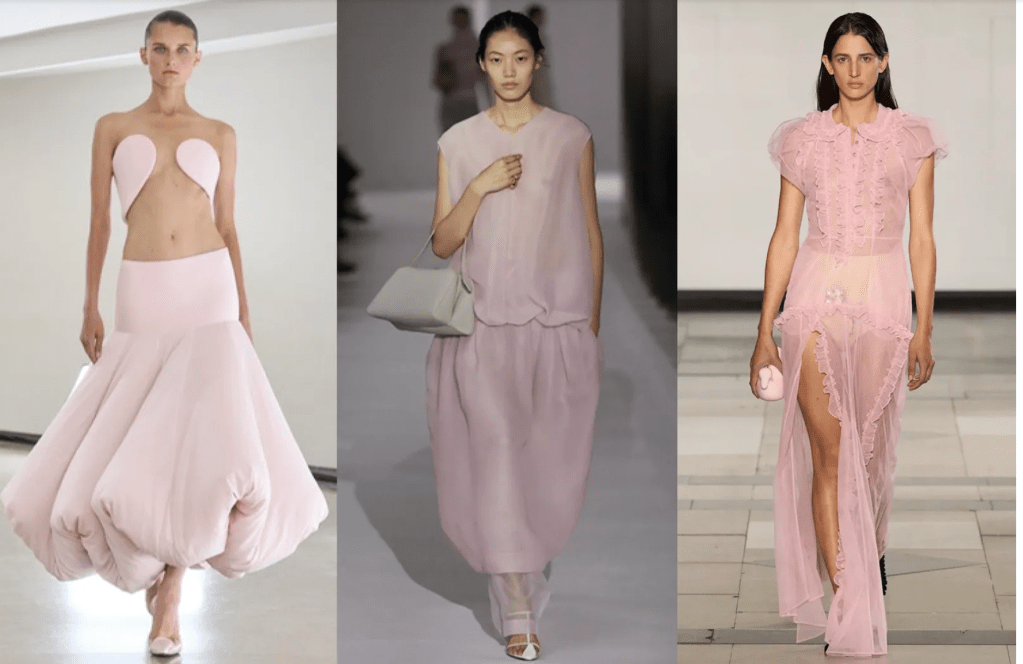
Perfect colour for all the minimalists out there, pair it with a crisp white cotton top, or Mocha Mousse to make this season your season. This pink looks best on cool or fair skin tones, but warm skin tones can enjoy it as well with a touch of peach or gold in the pink shade.
Some classics, Crisp blue cotton, this colour and combination of fabric and colour is no stranger to the runway. An essential everyday colour that makes the “fashion shows feel more attainable and inspirational to the broader consumer” (Vogue).Style with denim to get the ideal it-girl outfits. This colour, pattern and fabric look great on all skin tones; it highlights the lighter tones, while complementing the darker ones. It is a classic, yet fresh, what else do we need? Style with denim to get the ideal it-girl outfits.

As well as browns, to add drama to your closet.
The Moody Plum, Oxblood’s cooler older sister, is always ahead of her game. This colour is often showcased in more strict and strong shapes and silhouettes, looks best when worn head-to-toe tonal in tailoring or strong dress shapes, as well as in ties.

This colour might just be my favourite, the plum colour with undertones of red or blue can add a touch of drama and sophistication. Mocha mousse, Suede, Jersey, and leather? Yes please! This hue comes in all shades and fabrics to add texture and interest to our clothes and accessories. Often seen as shrunk jackets at Mui Mui, and draped jersey jackets in Gucci and Lemaire.

This colour can be a statement, but can also work as the perfect backdrop with any other colours of this season, with bright reds, yellows, you name it! Accessories like bags and loafers, essential for everyday wear. This is the colour of elegance, bohemian and minimalism.
And last but not least, bold colours to brighten your season.
Prime time colours! The primary colours are in. Retro sportswear has had a big hand in infusing these colours into our fashion this spring/summer. With Loeve and their ultra-short mini dresses, adding a sporty feel to the bold blue tones. And Prada, where their kitware gave an illusion of sporty polo tops. Primary colours came in strong and hot!

Clementine, to make our summer fresh and cool. Such zesty citrus shades have been quite permanent in runways, but with additional unexpected pairings, it has made this colour the perfect summer shade. From bohemian blouses with billowing khaki skirts from Saint Laurent (left), to draped blouses with butter yellow tops at Trove (right), this pop of citrus has taken over the floor. For the perfect summer zesty look, this colour is your answer.

As we enjoy these colours this spring/summer, and add them to our closet, we must also be mindful of how buying from high-end brands, that produce in mass, has a very big impact on our environment since Fashion is a very important aspect of our lives, as it allows us to socialise, as a form of self-expression and emotions. However, it may be hurting our environment. Many brands contribute to fast fashion, which is basically a design method focused on rapidly producing a high yield of clothing. It leverages trend replication and low-quality materials in order to bring inexpensive styles to consumers. Not only does it negatively impact the environment, but also workers, with excessive water, exploitation of labour and contributing to environmental pollution through textile production and waste disposal. But the good news is that we can work together to resolve this issue by buying fewer clothes, prioritising second-hand clothing ( thrift shopping is your best friend), donating and opting for ethical, more sustainable brands. Instead of buying from high-end brands, thrift these colours at Patagonia and People Tree.
With these colours, you can spice up your wardrobe this spring. We know fashion and its trends come back around; these colours have been prominent in the 19th and 18th centuries, and are now making their return.
By Tisya
 Elements Magazine